Colored No More by Treva B. Lindsey
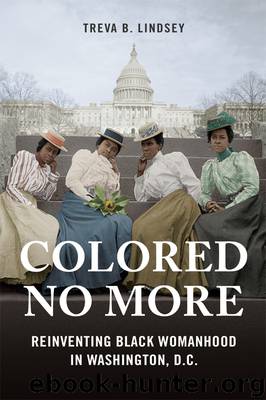
Author:Treva B. Lindsey [Lindsey, Treva B.]
Language: eng
Format: epub
ISBN: 9780252041020
Publisher: University of Illinois Press
Published: 2017-01-15T07:00:00+00:00
New Negro Women’s Suffrage Activism: Washington and Beyond
African American women in Washington capitalized on emerging Progressive Era ideals and the invention of new strategies for racial progress within African American communities. They founded organizations that attended to basic needs of African Americans as well as social issues such as temperance, the maintenance of the black family, and black female respectability. The majority of black newspapers in Washington focused on activism around issues such as lynching, economic disparities, and African American suffrage, efforts led by black men and supported by black women. The widespread, intraracial expectation for black women’s involvement in social and political movements for racial equality, nevertheless, was not leadership.38 Black women used their gender-specific organizations to promote African American political struggles for racial equality, to articulate new ideas about the future of African American women’s political identities, and to situate advocacy for gender equality within a still-forming and multifaceted political consciousness.
African American women configured an intraracial, gender-specific political culture that strategically employed an array of tactics that included but was not limited to the politics of respectability, self-determination, and racial uplift. Cynthia Neverdon-Morton argues that “even though black women living in different communities realized that there were some needs unique to their areas, they also understood that certain needs were common to all communities where African Americans lived.”39 The connection between the local, national, and, in some activist circles, international political struggles of peoples of African descent informed African American women’s political culture. Nearly all black women believed that they should have the right to vote. Although not all black women were suffragists, Paula Giddings explicitly states in When and Where I Enter: The Impact of Black Women on Race and Sex in America that “one would be hard pressed to find any Black woman who did not advocate getting the vote.”40 Black women political leaders rallied around this widely held sentiment. In Washington, African American women participated in suffrage organizations and in discourses regarding the significance of enfranchising black men and women alike despite their local predicament, which deprived them of the possibility for full representation in the body politic for distinct reasons. The specific needs of African Americans in Washington did not preclude black women from actively engaging in a political movement that would not improve their unique status as a triply disenfranchised community. Black women in Washington fought for suffrage on three fronts: as blacks, as women, and as Washingtonians.
All roads to a constitutional amendment for women’s or universal suffrage led to Washington. Cognizant of this, black women suffragists in Washington perceived their role in the voting rights movement as particularly significant. African American women in the District made the most of residing in one of the most cosmopolitan southern cities. They lived in a city with a more progressive politics regarding race and gender than other cities and towns to the south. Washington also had an established black community that provided financial resources and extensive networks for black women to build on as they forged new paths in African American political activism.
Download
This site does not store any files on its server. We only index and link to content provided by other sites. Please contact the content providers to delete copyright contents if any and email us, we'll remove relevant links or contents immediately.
| Africa | Americas |
| Arctic & Antarctica | Asia |
| Australia & Oceania | Europe |
| Middle East | Russia |
| United States | World |
| Ancient Civilizations | Military |
| Historical Study & Educational Resources |
Cat's cradle by Kurt Vonnegut(15362)
Pimp by Iceberg Slim(14515)
4 3 2 1: A Novel by Paul Auster(12396)
Underground: A Human History of the Worlds Beneath Our Feet by Will Hunt(12100)
The Radium Girls by Kate Moore(12033)
Wiseguy by Nicholas Pileggi(5791)
The Fire Next Time by James Baldwin(5451)
Perfect Rhythm by Jae(5408)
American History Stories, Volume III (Yesterday's Classics) by Pratt Mara L(5309)
Paper Towns by Green John(5194)
Pale Blue Dot by Carl Sagan(5012)
A Higher Loyalty: Truth, Lies, and Leadership by James Comey(4965)
The Mayflower and the Pilgrims' New World by Nathaniel Philbrick(4506)
The Doomsday Machine by Daniel Ellsberg(4492)
Killers of the Flower Moon: The Osage Murders and the Birth of the FBI by David Grann(4449)
The Sympathizer by Viet Thanh Nguyen(4396)
Too Much and Not the Mood by Durga Chew-Bose(4349)
The Borden Murders by Sarah Miller(4328)
Sticky Fingers by Joe Hagan(4204)
